Editorial
In the JAR36 editorial I began a line of thought that deserves further reflection given the ongoing impact AI has had on our work. That editorial concerned conflict and the ways in which conflict compromises through either implication or avoidance. In it, I speculated that 'we could aim to seek differences not compromised by conflict.' On the side of implication, I referred to the many open conflicts and wars; on the side of avoidance, I gave the example of doctoral education and the many submissions we receive from that context, which 'are compromised by specific strategies to avoid conflict, through modes of academic writing, the structure of arguments or the need for discursivity.' Since then, wars have proliferated further, while higher education's structures of avoidance have been deepened by AI technologies, a link that deserves a closer look.
AI has been affecting our work in several distinct ways. Central among these, of course, have been artists' engagements with AI in their creative practices — something that began before the arrival of large language models and transformer technologies pushed by global corporations, but which now carry a tangible concern about the fallout of such technologies. Not unlike the aftermath of the Covid pandemic, we see a striving toward sense-marking and a recalibration of meaning in changed conditions. Whatever one makes of this, new and different experiences have become possible that artistic researchers have been exploring. There is also a structural relationship worth noting between artistic research and current generative AI: both are part of what has been called the material turn. Despite operating across very different material horizons — whether physical, sensory or linguistic — what engages cognition is emergent rather than contained.
While artistic engagements with AI may produce substantial parts of a submission, its non-artistic use is a different matter and needs careful evaluation. Depending on one's writing style and the personal context set up for an AI agent, its use for proofreading or copyediting can be unproblematic. In fact, the cost of human copyeditors may be prohibitive for many prospective contributors and the work involved can be substantial, in particular for non-native speakers. It should not be underestimated how a badly written manuscript can negatively influence the review process, and we would always advise – despite the copyediting that we provide for submissions that we publish – that authors work on the legibility of their texts before submission. At the same time, similar to bad or cheap copyediting, AI does not push back at problematic passages and glazes over what is at stake in a passage. A text can read better and be grammatically correct, but it may not engage its content better, or a reader, for that matter. What for some may seem like bad style, can also be productive. Again, this parallels our experience with professional copyediting where some well-meaning copyeditors revised manuscripts to a degree where the author's voice or the grain of the text was lost and where we had to intervene. Given how quickly this can happen with AI where a simple prompt can be enough, there is a real risk that authors lose something they may not have known they had.
What is more, once AI has been let loose on a text, it is very difficult to reverse engineer something like a voice or the grain of a text, as mentioned above. Without wanting to speculate too much about what happens when we write, it makes sense to assume that all sorts of traces are left in a text. In my case, for instance, I am very aware that my vocabulary is not particularly wide, which is possibly due to English being my second language. If AI introduces terms that better express what I aim to say, on what grounds would I remove an arguably better word? Or if I keep it, am I sufficiently aware of the connotation it carries? When writing, I am acutely aware of my active vocabulary, which, through the use of AI, becomes inflated through a passive vocabulary pretending to be active. How am I to edit such a text, which I now read and not write? Of course, there are ways to utilise custom context and to improve how far AI is allowed to divert, but the principal question is not addressed in this way, since on whatever scale, we need to account for the impact an edit has.
Today, this experience extends to AI-generated media which for the most part employ the same transformer technology as text outputs. When media is structurally distinct, rich-media publications like JAR can rely on the fact that text is almost automatically interrupted. It can be seen as a strength of a journal such as JAR to actively seek such interruptions and challenge subordinate uses of media for the sake of artistic articulations of research beyond text. When media are generated through the same language-based processes as text, however, mediality risks becoming a surface phenomenon — images that look like images but carry the traces of their textual production rather than those of their own, different material production. The gap between written language and image, which rich-media publications like JAR engage with, is closed before the exposition begins. What appears as media is, at its point of production, language. This, too, is not unfamiliar to us: we have long seen images illustrating or decorating text rather than putting it into perspective through their aesthetic work. However, where that was a question of use, the AI-generated image forecloses the question before it arises.
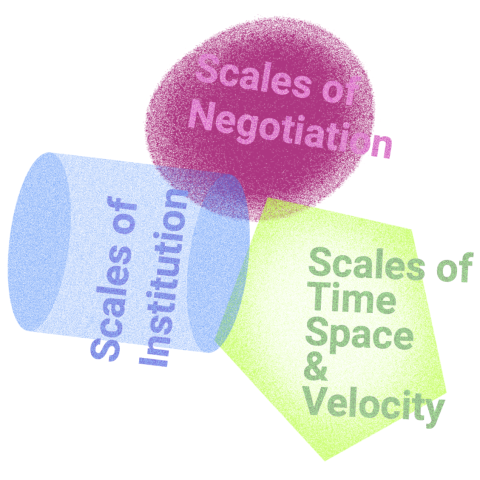
The difficulty of editing AI text thus extends beyond words or sentences to the specific integration of elements into a coherent exposition. If each element is formed only on its own scale, attunement to the exposition as a whole is missing, which provides the specific context within which everything will have to make sense and which progressively informs what elements become and how they are to interrelate. 1 A similar issue has recently been discussed in relation to AI-generated images: while they may broadly look like perspectival images, image elements project slightly different vanishing points resulting in an image devoid of the central organisation we know from optics and vision (Sarkar et. al 2024). Likewise, recent research on generative AI also suggests that while word or sentence level language is seen to have improved, coherence on the level of the document is weakening, strongly affecting the ideas the document can express. (Moon 2026) Both issues may appear as though they could be technically fixed, but only if an artist or author already knew where the vanishing point was to fall, or what idea the text was to unfold — that is, only if the image or text had in some sense already been made.
What the vanishing point and the document both reveal is that scalar attunement — the mutual shaping between part and whole that allows for expositions of practice as research — requires that artists and authors are implicated in the work at every level simultaneously. To be implicated is also to be exposed to conflict: between what a sentence wants to do and what the argument demands, between what a medium offers and what an exposition requires, between one's own voice and the grain of a thought not yet fully formed. AI's structural tendency to generate each element at its own scale is a systematic way of producing work from which implication has been withdrawn. Outputs then carry the surface of decisions without taking the risk that those decisions entail. In this sense, the scalar problem is the conflict problem restated at the level of form: to avoid the conflict of making is to lose the attunement that only that conflict can produce.
Whether it is academic form or transformer-generated output, both developments have the tendency to shield us from conflicts we should have when articulating artistic research. If conflicts of sense-making and questions of form are avoided, the images and texts we use have already been made – but by others, not us. Where there should be conflict – for instance with regard to regulations, funding or ethics – it is delegated to others with other interests not necessarily in service of knowledge, art or life, who have their conflicts elsewhere, be it the environmental, social or human cost of a rapidly changing technological landscape. In the end, it would not be surprising if open conflict and avoided conflict are two sides of the same coin, while approaches are needed that can work out what is at stake.
Michael Schwab
Editor-in-Chief
References
Kibum Moon, Kostadin Kushlev, Andrew Bank, Benjamin Lira, Indre Viskontas, James C. Kaufman, Dan R. Johnson, Angela L. Duckworth, and Adam E. Green (2026). The Creative Link Between Words and Ideas is Weakening in the AI Era. PsyArXiv preprint, 5 February. https://doi.org/10.17605/OSF.IO/YD94Z
Ayush Sarkar, Hanlin Mai, Amitabh Mahapatra, Svetlana Lazebnik, Anand Bhattad, D.A. Forsyth. (2024) Shadows Don’t Lie and Lines Can’t Bend! Generative Models don’t know Projective Geometry...for now. CVPR 2024. pp. 28140–28149. https://arxiv.org/abs/2311.17138
Michael Schwab (2026). “Local, Polylocal.” jar-online.net. 11/03/2026. https://doi.org/10.22501/jarnet.0089
- 1The relationship between context and scale is further elaborated in my keynote lecture Local, Polylocal published on the JAR Network pages. (Schwab 2026)