
This paper was delivered at the 17th Conference of the Society for Artistic Research, 25 June 2026, Galway, Ireland. Earlier versions were presented at meetings in Oslo, Helsinki, Turin and Brussels.
The title of my talk is Artistic Research and the Lingering Gaze of Thought. I can imagine that especially the last part of the title – ‘the lingering gaze of thought’ – does not immediately ring a bell. But I hope that by the end, it will become clear what I mean by that phrase.
My talk will be divided into three parts. In the first, I will say a few words about the place of artistic research within academia. Next, I will highlight four aspects of artistic research that are distinctive yet also shared with other research fields. In the final part, I will discuss discursivity and the possible role of words and concepts in artistic research.
Let me start with a reference to something that recently arrived in my mailbox, a message from the Australian Council of Deans & Directors of Creative Arts, DDCA, which is a board of directors of art schools and art universities in Australia. The message included policy updates on the evaluation of artistic research, also known in Australia as creative practice research.
There are several recommendations in that policy document addressed to the national research organisation, the Australian Research Council, among them recommendations about the importance of indigenous knowledges and about peer review. However, I want to highlight a specific recommendation concerning the labelling of Research Output. What is specific about the output of creative research or artistic research?
Now, Australia was, as far as I know, one of the first countries in the world (in the 1990s) to clearly acknowledge what came to be known as ‘Non-Traditional Research Outputs’. Here is how the Australian Research Council defines NTROs in the context of its research evaluation, Excellence in Research for Australia (ERA):
“In ERA, some research outputs do not take the form of published books, book chapters, journal articles, or conference publications. These are referred to as non-traditional research outputs (NTROs). Examples of NTROs include:
• original creative works
• live performance of creative works
• recorded/rendered creative works
• curated or produced substantial public exhibitions and events
• …” (Dataportal.arc.gov.au 2018)
Since then, many countries in the world have adopted similar definitions of the non-traditional outputs of artistic research, sometimes in heated debates with traditional gatekeepers, be they research councils, funding agencies, or libraries, who often are inclined to hit the brakes.
Since 2016, the Australian Council of Deans & Directors of Creative Arts (DDCA) has created a dedicated platform for research in third-cycle, tertiary artistic education, for doctoral research at art schools and universities, with the title NTRO. Here is the website of that platform.
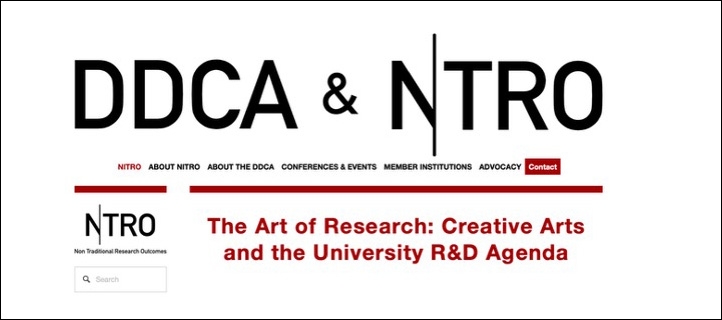
By the way, I could only capture this image of the website using the Wayback Machine from the Internet Archive. It is no longer online. Since 2023, the platform has changed its name to ‘Creative Matters’. Here is the archive of Creative Matters. Note that the original title of the platform, NTRO, is still retained in the page header.
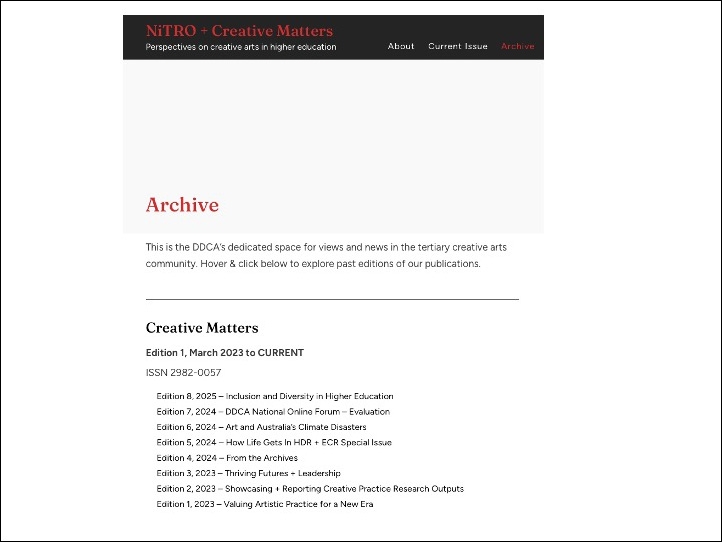
This change, from the title ‘NTRO’ to ‘Creative Matters’, anticipates the recommendation published a few months ago. The recommendation is to stop using the phrase ‘Non-Traditional Research Output’.
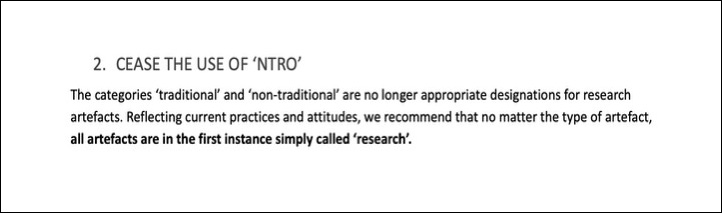
In the explanation of this recommendation, it states:
“Non-traditional is a definition already situated in opposition to and is thus marginalised. Given the development of the creative practice research field over the past 30 years, this opposition and marginalisation does not speak to the state of things as they are now. Not only this, but other disciplines outside of the ‘creative’ ones are expanding their research practices and methodologies, which are yielding research outputs outside of the scholarly paper, report or monograph.” (DDCA 2025: 5)
I will come back to the last part of this paragraph in a moment. The point I want to make now, with reference to this recommendation, is that we should indeed no longer define or view artistic research outputs in opposition to other academic research outputs, or more broadly, define or understand artistic research in opposition to academia. Instead, we should regard artistic research itself as a cutting-edge form of academic research.
But here the paths diverge; people disagree. Roughly speaking, one can identify two positions in the field. There are those who strongly oppose any alignment or rapprochement with the broader world of academic research. ‘Stay away from the sciences,’ they say, emphasising the autonomy and unique nature of artistic research. And there are those who are not afraid of academia, and instead seek to reform it from within, by creating space in academia for artistic ways of knowing and understanding, for artistic methods, for artistic outcomes, and for artistic ways of documentation, publication, and dissemination.
To be clear, I completely understand the reservations in our field towards the bureaucratic reality of university administrations, towards the uneven playing field when it comes to the funding of research, towards the resistance and even hostility in some quarters towards artistic research. As often happens, money and power threaten to corrupt what is at stake. So, it seems there are good reasons to defend a distinctive status for artistic research. But I am asking, isn’t there the danger of isolating oneself, of falling into isolationism?
I am asking this because, in my opinion, with the arrival of artistic research in academia, there is also an invitation – maybe even an obligation – to relate to, or even align with, other research programs, fields, and agendas in higher education. Having a separate position for the artistic research program and degree in academia doesn’t help and might frustrate such alignment.
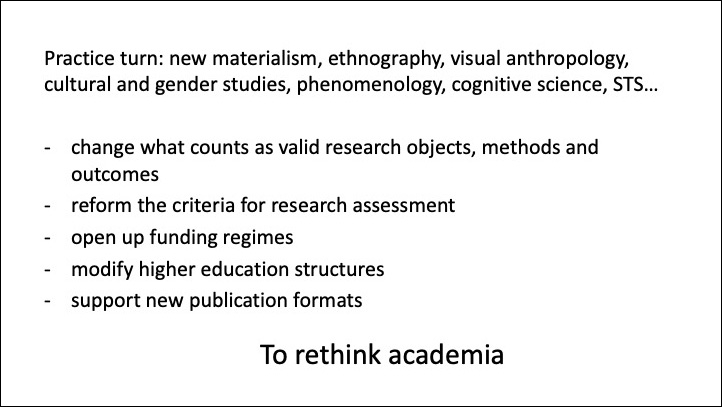
We share the ‘agenda’ of artistic research, with regard to unconventional forms of knowing and understanding, or advanced ways of investigating and reporting, with other fields and programs in academia; think, for instance, about visual anthropology. The ‘practice turn’ is also evident in programmes and fields like new materialism, ethnography, cultural and gender studies, phenomenology, cognitive science, science & technology studies. There is no reason to isolate us from the rest of academia; on the contrary, it is time to connect with others, with other research programmes and fields, in order to redefine what counts as valid research objects, methods, and outcomes; to reform the criteria for research assessment; to open up funding regimes; to modify higher education structures; to support new publication formats. In short: to reflect on what academia is or could be.
Let me now say a few words about what, then, seems so specific to artistic research. I will not give a complete picture – if that would even be possible – but will highlight what is relevant for this talk. Some of these aspects might be familiar to you, for which I apologise. On the other hand, a little rehearsal won’t hurt.
Some Aspects of Artistic Research
Practices and things
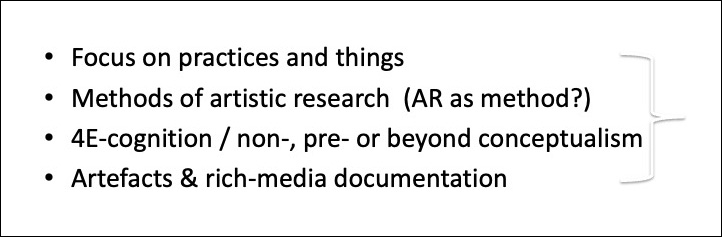
First, the focus in artistic research is on concrete practices and things; creative processes in the studio, performances, compositions, artworks, installations, artistic interventions, etc. It is not just that those practices and things are the subjects of study, as in ‘traditional’ humanities or social science research into art. In artistic research, the ‘agency’ of those artistic practices and things is acknowledged and emphasised.
This is in line with what is called the practice turn and the material turn in the sciences and humanities. We have revised our understanding of what practices and things fundamentally are; hence, the renewed interest in ontology. They are not innocent practices or dead material, but they speak to us – or speak back to us, to quote Mieke Bal (2012). I will come back to this ‘speaking of practices and materials’ at the end of my talk. In an epistemological sense, those practices and materials embody knowledge and understanding, and they are methodologically constitutive in generating that knowledge and understanding. These insights are also acknowledged in cultural studies, in anthropology and heritage studies, and under the label of posthumanism in what is now called new materialism, object-oriented ontology, or speculative realism.
Methodology
The second point I want to highlight concerns methodology. A few years ago, there was a conference in Prague with the title: ‘Artistic Research: Is There Some Method?’ This question can be understood in two ways: What research methods and tools are used in the field of artistic research? But also: does artistic research itself represent or exemplify a method?
What is nowadays called ‘methodological pluralism’ is widely accepted in the field of artistic research. Depending on the research topic and the aim of the research, one might use methods and techniques originating from the humanities, or the social sciences, or technology, or a combination, a triangulation of various methods and tools. That said, one can distinguish three aspects that are almost always present when conducting an artistic research project.
The first one is experimentation. The research takes place and unfolds in and through artistic practice, in and through making and playing. That’s why it’s sometimes referred to as ‘studio-based research’. The practice with materials and bodies has a performative force with epistemological weight. The objective of the artistic experiment is not so much to test something – like in a science laboratory - but to tell something, to find the right way to tell something, to convey content.
A second characteristic of artistic research is the inextricable involvement and engagement of the person or people conducting the research. Artistic research is often participatory research, and as such, it shows kinship with ethnography, and with those fields and programs that use ethnographic research methods, like anthropology and science and technology studies. Here, the researcher is intertwined with her research, and the traditional separation between subject and object, or the fact-value dichotomy, is relativised.
A third feature of artistic research is that, frequently, the research findings are accompanied by some form of contextualisation, analysis, or interpretation. Here, ‘theory’ can help to contextualise the research and show how it relates to other research and how it is embedded in academic, cultural, social, or political spheres and discourses.
So, is there some method? Yes and no. No, while artistic research often utilises and appropriates a wide range of research methods and techniques from other fields; this is the methodological pluralism side. And yes, because it is distinctive precisely in the way it can combine experimentation, participation, and interpretation.
Cognition
The third point I want to touch upon is knowledge, or better: cognition. I know that much has already been said and written about the ‘production of knowledge’ in artistic research. For this occasion, I want to confine myself to that program at the intersection of philosophy of mind, phenomenology, and cognitive science that understands cognition as reaching further or deeper than what traditional epistemology has taught us. Much of what is at stake in artistic research clearly goes beyond what can be expressed by concepts or words, think about the implicit, tacit grasp and understanding at work when we produce or encounter art, for example.
Under the label 4E-cognition, an exciting research program is blossoming, which is also relevant to our field of investigation. This program involves a wide variety of positions and controversies, which I cannot discuss in detail here. Roughly speaking, cognition is conceived, by some scholars, as embodied, which means that it depends on our physical makeup and is contingent on bodily processes – a position that goes back to Merleau-Ponty and the phenomenological tradition. Embodied cognition, which includes thought and consciousness (and aesthetic judgment), extends here beyond the brain. And this also implies a critique of the current hype around neuroaesthetics.
Cognition is also understood as embedded by other scholars, meaning it depends on our relationship with the environment or culture at large. The contingency of knowledge on culture, history, and also power has been emphasised in post-structuralism already for some time. And Donna Haraway’s work on ‘situated knowledges’ (1988), informed by gender studies, is an inspiration for many artistic researchers.
Some scholars in the philosophy of mind and cognitive science think of our cognition as materially extended. Our thoughts, beliefs, experiences, and memories, in short, our minds, are not physically contained or stored in our heads, under our skulls, but are also located in our environment. Think about remembering, such as recalling a phone number or a name, whether from memory or from your notebook or smartphone. Is there a difference? These scholars argue that the mind is working beyond the brain and our body in the world. By thereby extending our cognition, these scholars radically challenge the traditional mind-world dichotomy.
And finally, there is the enactive approach to cognition, where cognition is understood as dependent on our dynamic interaction with the environment. Here, it is not so much what we passively perceive or are subjected to that determines our cognition. But rather, how we act in the world and what we do within the triangle of brain, body, and environment determines how we organise ourselves, including our understanding of the world. This enactive approach strongly appeals to artistic researchers in music, theatre, and dance. In general, this approach to cognition provides a theoretical base for the performative dimension of artistic research.
In any case, in all four instances – embodied, embedded, extended, and enacted cognition – our cognitive capacities reach beyond our conceptual repertoire and grip. This makes the 4E-cognition paradigm highly relevant for understanding the epistemological relevance of artistic research, and in turn artistic research could function as an empirical laboratory where 4E-theories are tested.
Artefacts and articulation
The next point I want to consider concerns the outcome of artistic research. I have already said something about that in relation to the research evaluation in Australia. Generally, people agree about the standpoint that only when artworks are part of the outcome of the investigation – and they can range from concrete material artefacts to ephemeral performances or artivist interventions – only when the investigation delivers art can such an investigation count as artistic research.
Now, one should not forget that the material outcome of the research is not the research itself. Even the documentation of the research outcome – such as audio or video registrations of performances, exhibition catalogues, and so-called ‘artist-books’ – does not suffice as an account of the research. Additional work has to be done to articulate and communicate the research, to demonstrate that it involves ‘a process of investigation leading to new insights.’ What is this ‘additional work’?
In some circles, one thinks of this as the reflective or written part of the research (or of a PhD submission). There is the artwork, and there is the reflection. One can find such a distinction, for instance, in the regulations for the new artistic doctorate in Sweden, Norway, and Austria. But I am asking: doesn’t that slightly miss the point of artistic research, and of the intertwinement of theory and practice?
If we acknowledge, as I sketched earlier, the agency of material practices and things, and if we emphasize the importance of studio-based, practice-based methods, and if we furthermore acknowledge that cognition is embodied, embedded and enacted in practices and in interaction with things, then we should not hesitate to conclude that the reasoning (the reflection, if you prefer) is first of all located in the art work or art practice itself; or at least one should take the agency, i.e. the epistemic and methodological force of the artefacts into account, something that is also acknowledged in for example fields like visual anthropology.
The question in our field then is: How to articulate that reasoning? How to articulate the epistemic and methodological force of art? Here, I want to emphasise the importance of rich-media documentation, publication, and dissemination. This is a form of articulation – of writing, one could say – in which the various materials of the research, or the documentation of those materials – among which images, sound, videos – are woven together to make a point; materials, which may, but don’t need to include text. And you might know that one of the core missions of the international Society for Artistic Research is to support precisely these forms of articulation, these forms of documentation, publication, and communication. It does this by publishing the Journal for Artistic Research and by supporting and further developing the Research Catalogue platform.
Discursivity and reasoning
This brings me to a crucial point and to the third – and perhaps most delicate or speculative – part of my talk. One of the tasks we now need to undertake is to rethink what ‘discursivity’ means, what it is to make a claim in and through art, what reasoning entails, once we have accepted that practices and things in our field of inquiry are not only constitutive in a methodological sense, but that they also count as material articulations of the research. The title of this talk could have been: Rethinking Discursivity.
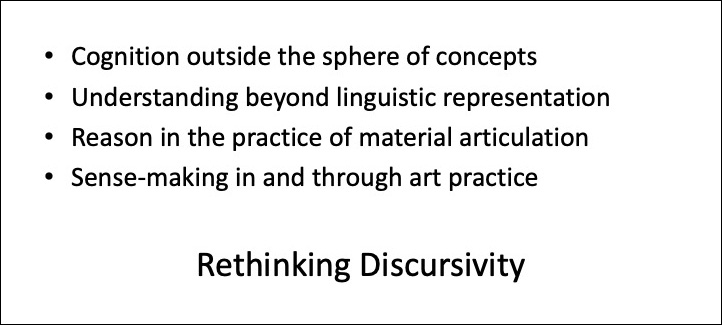
The traditional conception of discursivity presupposes that knowledge becomes legitimate only once it is rendered in conceptual or propositional form. Language, in this view, functions as the privileged medium of rationality. Yet, as among others phenomenology and contemporary cognitive science have told us, much of our cognitive life unfolds outside the sphere of concepts. Our sensorimotor engagements, affective attunements, embodied dispositions, and environmental couplings constitute modes of understanding and sense-making that do not pass through the bottleneck of linguistic representation.
I therefore propose to augment the concept of ‘discourse’. Already, Michel Foucault has broadened the meaning of the term beyond its association with language to include social practices and institutions that generate knowledge and exercise power. While his views on discursivity are important, I am concentrating on how reasoning also operates in the practices of material articulation, of enacting meaning through material constellations.
If we ask what discursivity might mean under these conditions, the answer cannot be a simple return to traditional forms of interpretative or explanatory writing. Instead, we must broaden our understanding of discursivity so that it encompasses material articulations: configurations of matter, sound, movement, image, gesture, rhythm that themselves perform operations that can be considered a form of reasoning. These operations may not be propositional, but they are no less rigorous for that. They delineate distinctions, evoke attention, establish relations, and open possibilities. They make sense. They constitute what could be called material reasoning, a logos enacted in and through matter.
Knowing
Let me approach the issue from yet another angle. The question of what discursivity means or might mean, what reasoning is in our field of investigation, also closely relates to questions about knowledge – that is, about how words, language, concepts, and thoughts hook onto the world – how they are about a world relatively independent of our thinking.
These questions about knowledge are as old as philosophy itself, and a rough glance at the history of philosophy tells us that here, only limited progress has been made. We still do not quite understand how our epistemic attitude, our cognitive attempt to understand the world, to grasp the world with our concepts and thoughts, succeeds in bringing the world home. Contemporary cognitive science – which emphasises the interdependence of mind, body, and world – can be seen as a step forward. In a sense, these 4E-cognition programmes have nuanced and relativised our epistemic pretensions.
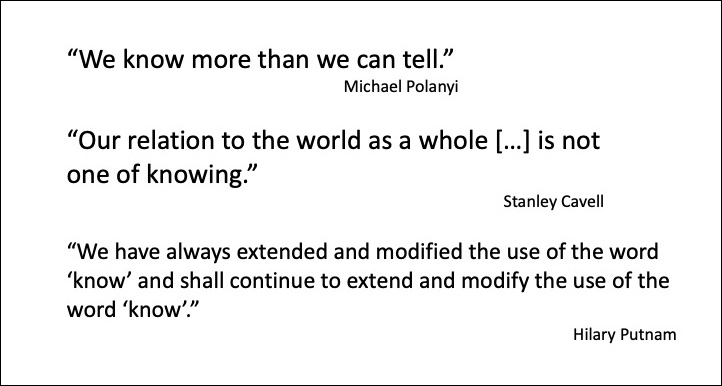
On one hand, we can say that ‘we can know more than we can tell,’ to quote Michael Polanyi (1966, 4). There is a pre-reflective intimacy with the world, which evades our linguistic and conceptual grip – a non-conceptual form of knowing and understanding, which is now increasingly acknowledged in academia, as the examples of cognitive science and visual anthropology show.
Now, artistic research makes us acquainted with the fact that the materials and things we encounter and deal with are in some way foreign to us, precisely because we do not succeed in, or even intend to nail them down with our theories and concepts. They, after all, escape our conceptual grip. At the same time, artistic research reveals that our natural relationship with these materials and things is more intimate and profound than what we can know, in the narrow sense of knowing.
In art, we sense something of our pre-reflective intimacy with the world, while simultaneously realising that we will never explicitly understand what lies there in plain view. When we listen to or make music, look at or produce images, or identify with body movements, we are brought into touch with a reality that precedes any representation in the space of the conceptual. In a certain sense, this reality is more real and closer to us than the reality we try to approach and capture through our epistemological predispositions. In the words of Stanley Cavell: ‘Our natural relation to the world’s existence […] is closer, or more intimate, than the ideas of believing and knowing are made to convey’ (1996: 257). ‘Our relation to the world as a whole […] is not one of knowing’ (1979: 45).
One could therefore argue that a distinctive characteristic of artistic research is that it articulates both our pre-reflective familiarity with the world and our epistemic distance from it. It owes this to a special quality of art-practice itself, which at once invites and evades an epistemic stance. This is reminiscent of Immanuel Kant’s characterisation of the aesthetic idea as a ‘representation of the imagination which induces much thought, yet without the possibility of any definite thought whatever, i.e., concept, being adequate to it, and which language, consequently, can never get quite on level terms with or render completely intelligible’ (1790 (1952: 314)).
So, how should we understand ‘knowledge’, or ‘knowing’, in this context? In an article I wrote some time ago about the ‘production of knowledge in artistic research’, I made a plea for the term ‘unfinished thinking’, in order to highlight the fundamental open character of material thinking in and through art. Art invites us to think, and artistic research is an articulation of this unfinished thinking. Knowledge is not confined to ‘justified true belief’, as it is coined in conventional analytical philosophy. It is historically and systematically contingent.
That contingent and open character of knowing and thinking is well expressed by the American philosopher Hilary Putnam, who wrote:
‘You won’t […] tell us, nor could you possibly tell us, what the criteria are by which we know which uses of ‘know’ in the future will be legitimate or rational.’ And ‘We have always extended and modified the use of the word “know” and shall continue to extend and modify the use of the word “know”’ (1995: 32).
So, art invites us to think, but (to paraphrase Kant) ‘without the possibility of any definite thought […] being adequate to it’. And artistic research is an articulation of this unfinished thinking.
Conceptual mimesis
Key to artistic research is the enactment of meaning through material constellations, which may, but don’t need to, involve the employment of language. Now, whenever one also uses words and concepts to articulate the research, the question arises as to what the relationship is between language and practice. Let me finish my talk with a few remarks about this.
In some contexts, one is expected not only to show or perform the work one has done, but also to deliver a verbal, a written component that, as it were, supplements the work. This written or verbal component that accompanies the material research outcome may go in three directions. Many people place emphasis on a reconstruction of the research process, clarifying how the results were achieved. Others use language to provide an interpretation of the products and practices generated by the research. They generally rely on ‘theory’, often borrowed from continental philosophy. A third possibility, however, is to express something in and with language that can be understood as a ‘conceptual mimesis’ of the artistic outcome.
Here, it’s not that words and concepts give us direct access to the thing at hand – that straightforward approach falls short and might even cause harm or damage – but rather, the thing at hand can reveal itself in some way when words and concepts gather in constellations around it and, in a sense, cling to (embrace, hug) the thing. This is not about propositionality or representation, but about resonance and responsiveness.
So, thoughts and concepts still hold value. The concepts, thoughts, and words assemble themselves around the work of art, so that the artwork begins to speak under ‘the lingering gaze of thought.’ In contrast to an interpretation of the artistic work or a reconstruction of the creative process, the latter approach involves an emulation or imitation of, or an allusion to, the non-conceptual content embodied in the art. Here is the quote from Adorno that inspired me to give this talk.
“Entäußerte wirklich der Gedanke sich an die Sache, gälte er dieser, nicht ihrer Kategorie, so begänne das Object unter dem verweilenden Blick des Gedankens selber zu reden” (1966: 36)
I started my talk with a reference to the Australian Council of Deans and Directors of Creative Arts (DDCA), which recommended abandoning the notion of ‘non-traditional research output’. They are right. Academia should embrace and incorporate our advanced understanding of knowing, investigating, and reporting. However, there is still, every now and then, the challenge of finding ways to gather words and concepts around works of art, letting them speak without damaging them.
Thank you.
References
Adorno, Theodor W. 1966. Negative Dialektik (Suhrkamp)
Bal, Mieke. 2012. Double Exposures: The Practice of Cultural Analysis (Routledge)
Cavell, Stanley. 1979. The Claim of Reason (Oxford University Press)
——. 1996. ‘The Ordinary as the Uneventful’ in The Cavell Reader, ed. by Stephen Mullhall (Blackwell)
Dataportal.arc.gov.au, <https://dataportal.arc.gov.au/era/nationalreport/2018/pages/section1/non-traditional-research-outputs-ntros/> [accessed 3 July 2026]
DDCA. 2025. ‘New designs on research evaluation: Recommendations’, <https://ddca.edu.au/wp-content/uploads/2025/09/DDCA-Evaluation-Framework-Recommendations.pdf> [accessed 3 July 2023]
Haraway, Donna.1988. ‘Situated Knowledges: The Science Question in Feminism and the Privilege of Partial Perspective’, Feminist Studies 14.3, pp. 575-599
Kant, Immanuel. 1790. The Critique of Judgement (1952 English edition) translation by J.C. Meredith (Clarendon)
Polanyi, Michael. 1966. The Tacit Dimension (Routledge)
Putnam, Hilary. 1995. Pragmatism (Blackwell)
Biography
Henk Borgdorff is emeritus professor of Research in the Arts at the Academy of Creative and Performing Arts (ACPA), Leiden University and the Royal Conservatoire, University of the Arts, The Hague. He was editor of the Journal for Artistic Research (until 2015), co-founder of the Research Catalogue, and president of the Society for Artistic Research (2015-2019). Borgdorff has published widely on the theoretical and political rationale of research in the arts. See his profile page on the Research Catalogue: https://www.researchcatalogue.net/researchers/7033