
Con/text and para/text. the 'Alma Mater' of Chile
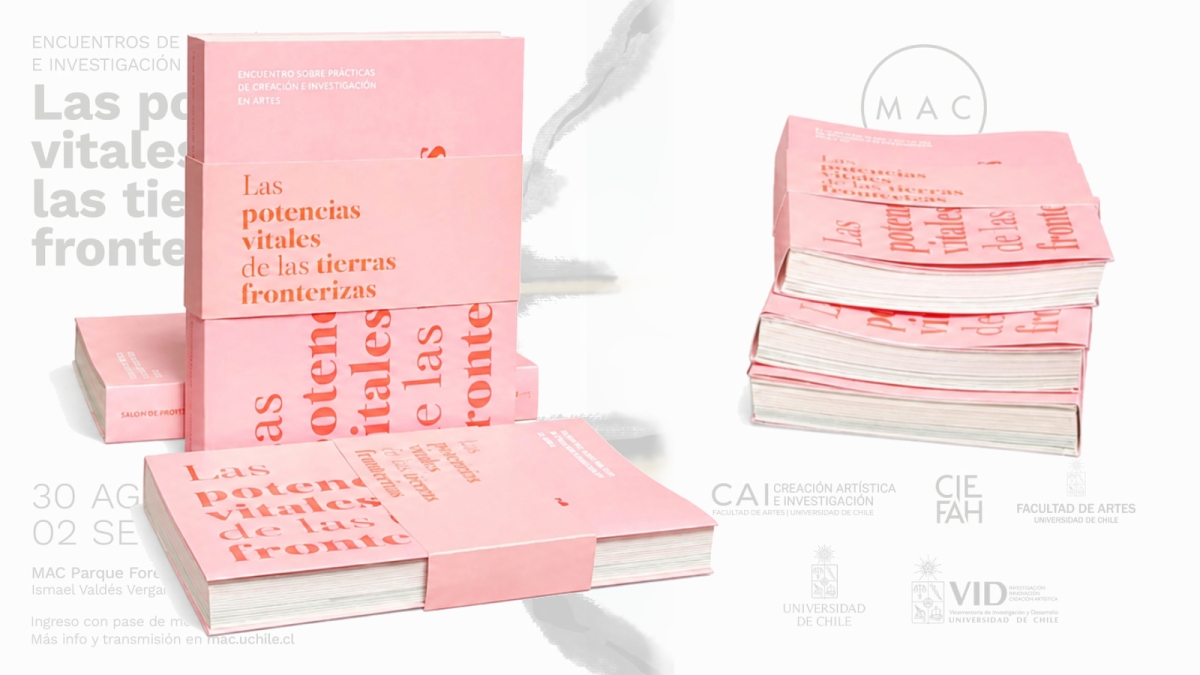
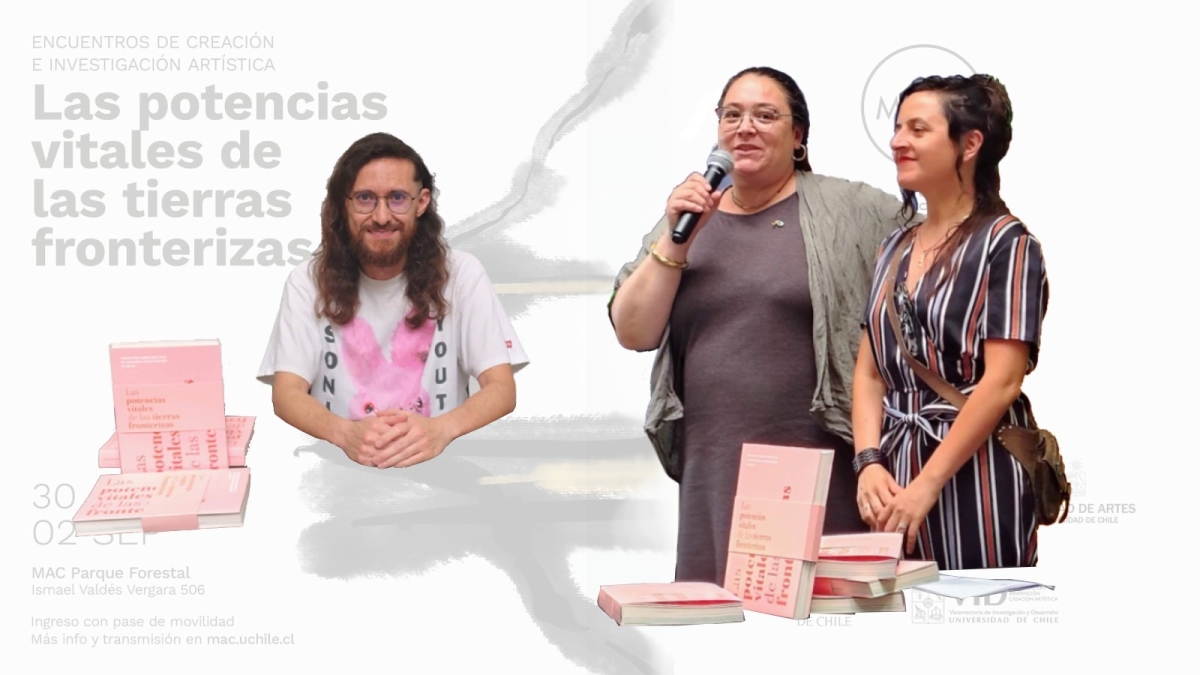
Edited by Ana Harcha, Francisca Montes and Felipe Cortés, the book Las potencias vitales de las tierras fronterizas. Encuentro sobre prácticas de creación e investigación en artes (The Vital Powers of Borderlands: A Symposium on Creative and Research Practices in the Arts) stems from the first of these symposia held at the University of Chile between August and September 2022. The event was organized by the departments of Creation and Research — then headed, respectively, by Harcha and Montes; and with Cortés as Project Manager and Analyst — of the Faculty of Arts at this state institution. The University of Chile has its roots in colonial institutions (the Royal University of San Felipe, 1758-1839) and has become a pillar of the country's republican life, which began its process of Independence in 1810. As for the arts, it has successively housed, amongst others, the Academy of Fine Arts (founded in1858), the National Conservatory of Music (1849), the Experimental Theater, the School of Dance (both 1941) and the Museum of Contemporary Art (MAC, 1947), where the event took place. Due to its public role, it was subjected to intervention, repression, dismantling and defunding during the dictatorship. As a result, it suffered a massive setback during the 1970s and 1980s and, in the decades that followed, although democracy returned and, with it, autonomy, it remained at the mercy of neoliberalism. This decline helps to explain why the book I am reviewing is situated in research in the arts — not in the Borgdorffian sense of practice 'in' the arts, but as a field of knowledge — as a publication of 'creation and research'.
This notion became most evident following the massive student protests of 2011 against commercialization of education, when research and its academic production began to be used as criteria for university accreditation (and recruitment), alongside teaching and the awarding of degrees and professional titles. Probably because there was no gradual and relatively autonomous evolution towards what, in JAR, we know as artistic research, the requirement is interpreted by the artistic-academic establishment as an imposition by science, if not by the knowledge industry. In fact, to this day in Chile, there are few textual forms generated by artists, primarily linked to mediation, whereas writing is left rather to theorists and critics. This suspicion of research is fueled by a distrust of the technocratic regime established during the dictatorship and perpetuated after it, meaning that academic artists demand that creation also be valued in their specific fields of production, which leads to different organizations and university mechanisms for its promotion. Strictly speaking, the tension between creation and research persists to this day, but Las potencias vitales de las tierras fronterizas signals a shift in this regard. If a border is conceived not as a strict boundary, but as a porous one, the significance of this publication is that it allows mapping a plurality of possible transits and traffic between the indicated poles, with their consequent mutations. As we will see, this is inseparable from the feminist Tide of 2018 and the Social Uprising of 2019. Equally disrupted in these processes, the 'Alma Mater' of Chile makes us see, with its critical, poetic and political 'reloaded' sensitivity, that just as nothing is ever fully said in matters of creation, neither is it in matters of research.
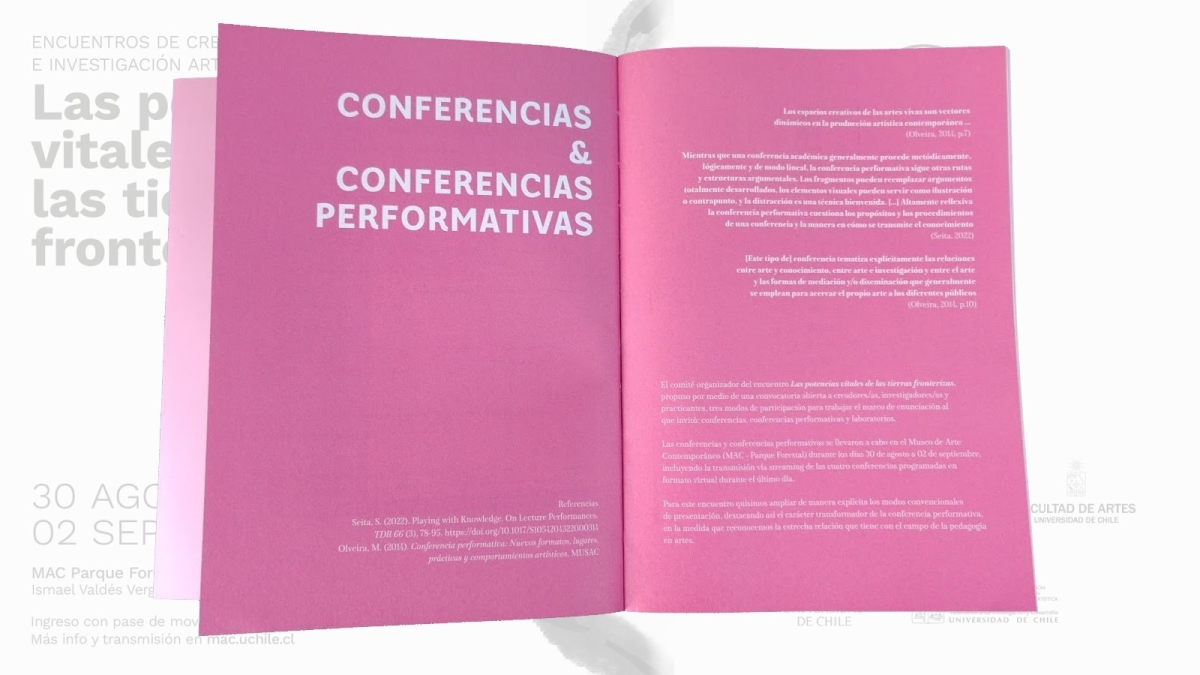
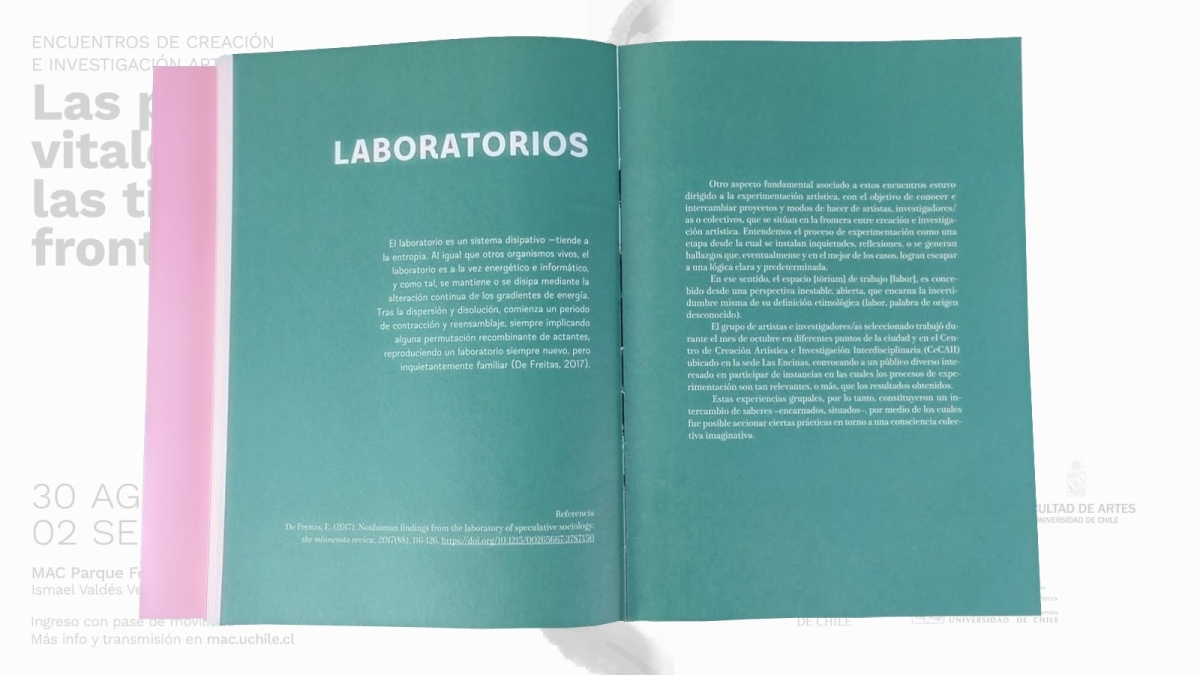
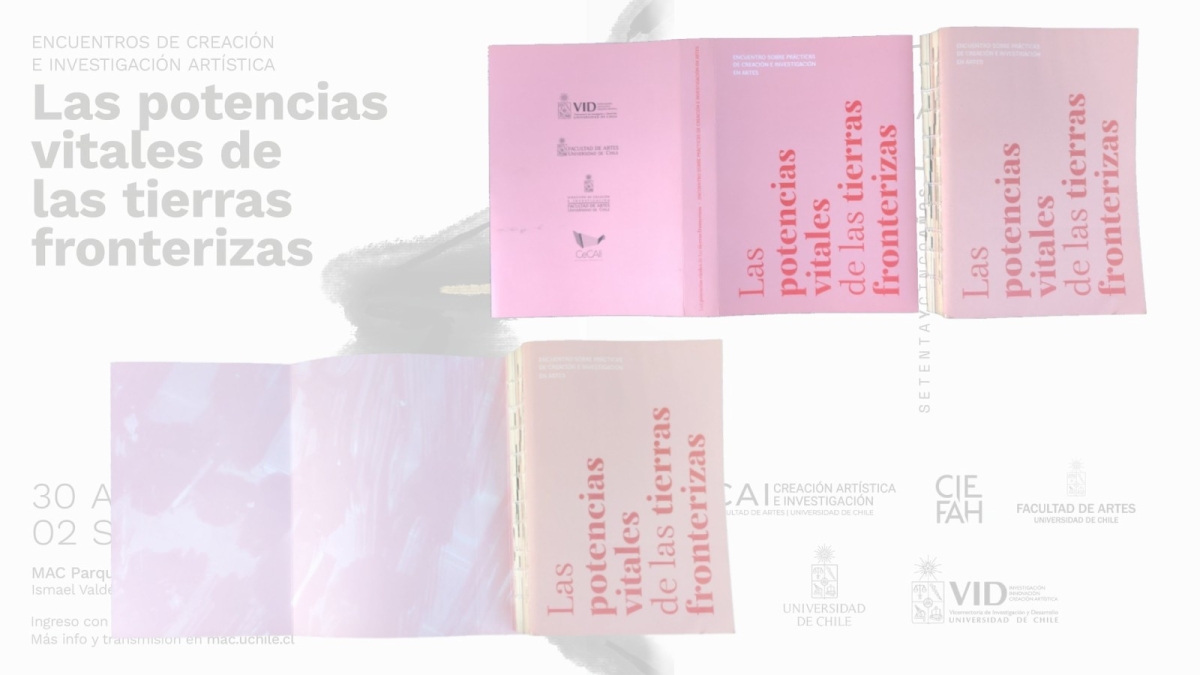
Precisely because it is located on the frontier of creation and research, in Las potencias vitales de las tierras fronterizas what is ‘said' transcends mere argument; this physical book (and its digital counterpart) stands out for its colors, its size and its packaging. Lacking covers and spine, it is protected by a dust jacket with flaps and a strip of paper in watermelon tones, differentiating the interior modules as 'Lectures' (conventional, performative and virtual) and 'Laboratories' by their respective accents in watermelon and green. Within 'Lectures', the sections follow the four days of the event. The text-visual articulations of each chapter vary, but the book shows a clear intention to express something situated beyond the written word. Thus, the typography is consistent, but the texts stand out in colors, and the images do not have a single format or placement. This 'something' is also manifested through a poetic style of writing evident from the title itself, and through the use of the epigraph as a device that varies in genre (summary, quotation, reflection, etc.), size and length in each contribution, functioning as a support for a polyphony. All of the above breaks with traditional academic publications. In their 'Forewords' (8-13), the editors point out that the aim, from a university's perspective, is to question the role of the arts in the 'knowledge society'; a question approached from the notion of border as a 'wild' interstice in displacement. They then introduce three 'frameworks for action' that they formulate as calls, since their presentation corresponds to the call for contributions for the Symposium. In order not to repeat ideas, I will elaborate on them in the corresponding sections.
The Lectures
While the 'framework for action' of 'Day 1' lead to a call to think of disciplinary relations at the border as a 'place situated-between-parts', the contributions focus instead on an initial and broader formulation of these parts 'as practices, as territories, as living and non-living beings, as disciplines, as knowledges' (p. 10-11). Thus, in elaborating the performative lecture he presented at the symposium, Kevin Magne Tapia (CINESPECIE / DS) states that, by expanding into artistic-performative methodologies, the 'chemical body' formed from a triple therapy against HIV creates its own science of experimentation and knowledge, but as an 'agitation of temporal and affective knowledge' of a collective and subaltern nature; using the title 'The raw material of a theoretical framework in size 12', Zoila Schrojel (EECh / DICTA) presents black and white photographs of a female body with different concepts written on it (bibliography, territory, politics, art, academia, leisure, smell, decolonization, etc.), presenting an embodied proposal of art as research; and Diego Pérez Pezoa (ARTESUCHILE) critiques the 'art world', proposing to combat it as a 'system of ego competition' through an ecosophy of leisure and contemplation that diverts it from mere production. In this 'Day 1' section, we see not only a diversity of possible articulations between creation and research, but also a shared critical and poetical engagement in experiences located inside/outside both the artistic and academic 'worlds', configuring a matrix of multiple imaginative agencies that mutually potentiate those articulations.
On 'Day 2', there was an invitation to question the call to innovate and 'be creative', proposing to conceive the border as a 'place of friction' based on 'one's own positions and ideas' and, especially, on pedagogical experiments in contemporary art. Here, Carlos Ossa (FCEI UCHILE) proposes to adopt, in the school curriculum, visual analysis methodologies that, by engaging with the assumption that images ‘make’ things, have a contextual, participatory, collaborative and intercultural character; Daniela Sabrovsky (FCEI UCHILE) reflects on 'machines of creation' that open up a 'space of play as ritual', ideas she uses in her teaching/experimentation/undergraduate research around cinema as a process; Fernando Huayquiñir Echeverría (CITP) introduces, as a process of 'co-learning,' how blind people perceive the city — research that he carried out in the field of geography, combined with ethnographic and creative methodologies; and Paola Medina (visual artist) reflects on the self-learning experienced in a journey from Mexico to Chile and through the Chilean desert, evoking the theoretical-affective referents of her 'IAD' (Investigación Artística Deseante, Desiring Artistic Research) and performing her aesthetic and poetic methods in the lecture she presented, as well as in the text about it. Thus, we see how pedagogical processes not only occur at different levels, dimensions and relationships, but are also enhanced through methods of research and creation that allow us, as Sabrovsky says, to 'touch the world'. The co-investigative perspective of this section dignifies Chile’s lagging education system, as well as framing art education as a process that can be carried out inside and outside the classroom.
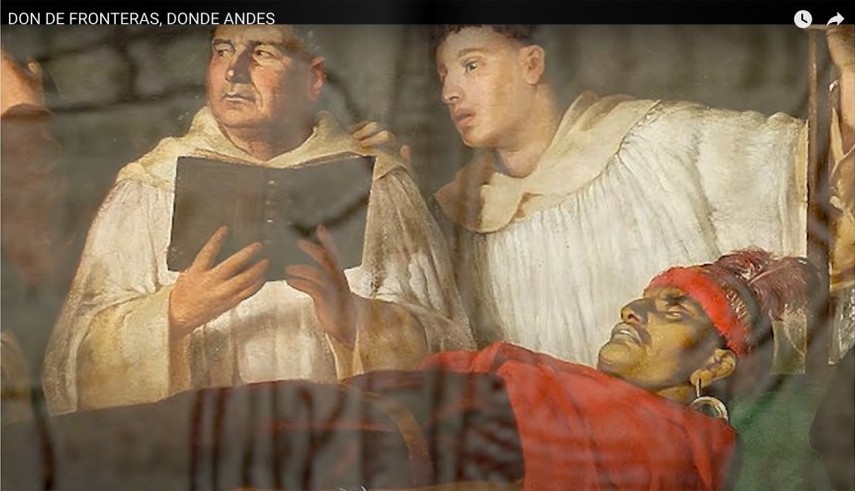
On 'Day 3', participants were invited to reflect on discussions within institutions and public policy, as well as on their 'latencies', to recognize 'other/new ways of generating knowledge' (p. 12). In a poetic, historical and visual essay, Andrés Ajens (Mar con soroche / UMCE) notes that looking at oneself always entails 'the horror of oneself', as the self is crossed by 'an uncertain border'. He addresses it in relation to the linguistic, cultural and literary boundaries implied in the 'Huanca of the end of Atahualpa', as well as in the very notion of 'huanca' and its uncertain translation as 'tragedy'. The title of the essay is:
‘Don de fronteras, donde Andes. Del Ataw Wallpaj p’uchukakuyninpa wankan alias “Huanca del fin de Atahualpa”, aguayo anónimo, ss. XVII-XIX, c. Potosí/Chayanta’,
(‘Gift of borders, where Andes. From the Ataw Wallpaj p’uchukakuyninpa wankan alias “Huanca of the end of Atahualpa”, anonymous aguayo, 17th-19th centuries, c. Potosí/Chayanta’),
And its only image, the cover of a video made by Manuela Thayer and featuring readings by Ajens and Diether Flores Chumacero, is [click to play]:
In the 'danced essay' based on her autoethnographic performative lecture, Luz Condeza Dall'Orso (DANZAUCHILE) elaborates on the contradiction of being a dance academic whilst being a ‘fat’ woman, through a form of 'overflow' artivism, strengthened by the mobilizations of 2018 and 2019. Ajens's erudite writing recalls the critical texts of dictatorship in its dense obliquity, while Condeza's is firmly rooted in the disruption of recent times. Both share an expositional eagerness that thickens the layers of meaning provided by the new modes of knowledge that aspire to recognition, as well as by the agents that, through them, address us directly or spectrally. In this context, the lack of contributions on public policies in these areas points to a worrying institutional imbalance.
On 'Day 4. Virtual lectures', with the support of video-performative images, Janaina Carrer (CÉLIAHELENA / PyEM / UCLM) focuses on the philosophical creation — following Deleuze & Guattari — of two concepts: 'conceptáfora' ('concept' / 'metaphor') and 'dis-autonomy', a disease suffered by her father; proposing to 'dis-displace' the idea of vertical autonomy with another, inclined, codependent, vulnerable, exposed and relational. Talma Salem (UNC / UPC), in her part, addresses her remontage or reenactment of the 'body-installation' of the Brazilian artist Vera Sala, specifying how her 'desire for archive' and her 'anthropophagic' practice are distinguished from mere appropriation — drawing on Suely Rolnik — because it does not seek to control the effects of the other ‘devoured’, but to ‘inhabit a borderland’ where its ‘living presence’ is felt. To this, she adds the idea — based on African thinking, and following Leda Maria Martins — of a curved 'spiral' time as a memory of 'embodied knowledge'. Arising from doctoral theses, these two South American contributions may well respond to the first framework of action of the symposium: in Carrer’s case, the discussion focuses more on concepts, whilst in Salem’s, on methodological aspects. The theoretical emphasis they share allows to zoom in to what happens in the artistic exegesis. By cross-referencing and expanding on their own reflections, it can even be observed that Practice as Research is not configured as an imposition, but rather as a way of transiting, from the arts, through research as a new territory of creation. This transit is sustained by devouring others, human or not, within a continuous decentering of the self that reorders the world by reconceiving it in affected and affective ways.
The Laboratories
The green section of the book, entitled 'Laboratories', contains six contributions, each of them associated with experiments carried out on 'the border between artistic creation and research' (p. 179). The CEIS8 collective presents various 'notes for a (non) workshop program in film formats', which deal with darkness, light, shadows, time and the methodology of painting in motion used to create a 'film without a camera'. Francisca León (UCSH / UNAB) describes an activity involving 'the visual arts, landscaping, philosophy and community experiences of interventions with plants and vegetables in urban public spaces', followed by another brief text that highlights what was shared around various real and/or metaphorical gardens, along with drawings and documentary photographs. Nuri Gutés (UCHILE) and Daniella Santibáñez (performing artist) provide a brief description and photographs recording a bodily and material activity that consisted of 'modifying our vision habits' around a wall that separates a garden and the street. In all three cases, the explanatory component is reduced to a minimum, as if the knowledge generated within the groups was meant to remain there or be communicated primarily through artistic materials. These laboratories revolve around the pole of artistic creation, while creating their own ‘science[s] of experimentation and knowledge’ (Kevin Magne Tapia) in order to generate, as the editors state, an ‘imaginative collective consciousness’ (p. 182). Through those notes that synthesize the knowledge generated and acquired, the proposal of the CEIS8 collective is simple, but effective. in terms of making us participants in what was imagined. Perhaps for this reason, in the design of the book, some of the images extend beyond the chapter, serving as cover images for the entire section.
In the following three chapters, whilst the visual component remains important, it takes a back seat to the written word. Made up of Isabel Jara (Theory of the Arts), Francisca Morand (Dance), Mónica Bate (Visual Arts) and Javier Jaimovich (Sound), the Emovere Nucleus (UCHILE) develops the concepts, details the exercises and reflects on the assembly impressions of the participants, extracting the 'organizing latencies' of their laboratory, understood as a 'form of physical and conceptual intra-action' where the human body, vegetation and electronics were combined. Accompanying their text with photographs, spectrograms and links to audio files, Federico Eisner Sagüés (PUC), María Consuelo Robledo (social anthropologist), Carla Tapia (actress) and Lautaro Casas (experimental musician) explain how they focused on the whisper to obliquely and materially recognize their voices, questioning — after performing different exercises — whether this constitutes a 'non-voice'. Finally, Christian Parker (documentary filmmaker) characterizes deep listening (DL) as a 'tool for the development of consciousness' through different exercises; to which he adds that the institutional context allows for the thwarting of the 'not-knowing-what-it's-about’, facilitating the objective of '(interrupting) the interruption'. Each of these three contributions helps us understand how to develop, think and communicate collaborative and participatory creation-research experiments: from an interdisciplinary approach that integrates a textual theoretical pillar, in the case of Emovere; from a transdisciplinary approach where plural voices emerge under the guidance of a specialist, in the case of Eisner et al.; and from the indiscipline of a form of knowledge not mastered by the institution, but which is empowered within it, in the case of Parker.
Let no one be left behind
Viewed from a cross-cutting perspective while also focusing on differences, what stands out in Las potencias vitales de las tierras fronterizas is firstly, the political relevance acquired by a notion of 'creation and research' situated, in this case, in the field of research 'in the arts', which encompasses investigations carried out either on, for or through the arts. These modalities of research, different from the disciplines and their methodologies, concern epistemological status, that is, whether art is an object, recipient or process of generating knowledge; a process which, in turn, has its own variations. For example, the book presents the research on the arts of Diego Pérez Pezoa or Carlos Ossa and the research through the arts of Zoila Schrojel or Fernando Huayquiñir, which can be typified, respectively, as artistically embodied research (or art as research) and as research based on the arts, or drawing upon them from other disciplines and problems. Acknowledging this multiplicity is politically relevant because its real-world counterpart of actors within or linked to universities generates an open and plural ecosystem of creation and research that, like humus, can foster more harmonious versions, or not, given that deviations also exist. In a context in which there is a tendency to enshrine and treat (Artistic) ‘Practice as Research' (PaR) as the ultimate goal, showing that there are multiple and fruitful possible articulations between creation and research allows us to keep alive a sense of curiosity and imagination regarding how these modalities are connected to the production of knowledge.
Even so, in this volume there is a prominent presence of contributions that could be characterized as PaR. The book begins with the presentation of Kevin Magne and includes those of Daniela Sabrovsky, Paola Medina, Luz Condeza, Janaina Carrer and Talma Salem, as well as those of Emovere, Federico Eisner (in collaboration) and Cristian Parker. Among them, Emovere's contribution is probably the one that shows the greatest affinity with the language, issues, theoretical-epistemic references and procedures of PaR, to which it explicitly alludes. This interdisciplinary artistic collective has been working since 2014, showing signs of consolidation. However, the other contributions, drawing on other backgrounds, also show command and ease in terms of exegesis or explanation of their processes and findings. Unfettered creativity constantly diffracts research processes and redefines what we understand by 'knowledge'. For example, with regard to the performative lectures and certain workshops, several contributions do not attempt to transfer the experience in situ to the publication, but rather elaborate different text-visual proposals, which incorporate the encounter: allusion is made to the discussions held at the tables (Magne); fragments of the performance are inserted (Medina, Condeza); or one writes about what was experienced and created with the participants (Eisner). This generates an assembly of relational and situated moments and memories that further complicate and enrich the relationships between ‘creation and research’, their hows, their whos, their whys, etc. However, even the silence that in some cases is maintained in the face of these questions — and which in another publication might seem anomalous — takes on, in the context of Las potencias vitales de las tierras fronterizas, the significance of a mysterious and dense interpellation.
In fact, a very interesting aspect of Las potencias vitales de las tierras fronterizas is that, more clearly than in other publications, it highlights the connections between creative practice and research and communities under threat. This is so evident that one is led to wonder to what extent it is possible to conceive of the epistemologies of PaR in isolation from the epistemologies of specific individuals and communities struggling to preserve and forge social, political, ecological and other bonds. Thus, the book is rich in references to feminism, queerness, indigenous or Afro-descendant knowledge, amongst others, humans or not, and it links these to specific experiences of illness, disability, obesity, alienation, etc., against the menacing backdrop of past and present genocides and global warming. Building on this, the book outlines the activities of a multitude of individuals grouped into more or less broad and stable formations conversing, knowing in general and knowing themselves, thinking in general and thinking about themselves, devising, imagining and creating new ways of acting for social transformation. In Chile, an intense manifestation of the above took place during the student mobilizations of 2011, the Feminist Tide of 2018 and the Estallido of 2019. Are revolutions gigantic social laboratories of creation and research where what is known, what is thought and what is felt are completely overturned? The contributions of this book were written to a large extent in the wake of these processes, reminding us that they are unparalleled in our country in terms of artistic experimentation, demonstrations of affection and the trafficking of knowledge involved. All this was crowned by a failed constitutional process, but the longings for dignity have not been given up. The most interesting part is that the implicative dynamics underlying the processes of creation and research are not only pointed out, but are also replicated through laboratories open to the public, permeating and mutating both the institution and the society in unexpected ways.
Just one day after the end of the symposium, the Chilean electorate massively voted to reject the proposal for a new Constitution generated thanks to the protests mentioned above. Will it continue to be possible to explore the boundaries between creation and research in universities, given that there are attempts to replace the human with machines and that even science is, nowadays, under attack from those who govern us? The University of Chile has carried out valuable work in fostering civic engagement in recent years, but, due to its state-run character, it could still receive a fatal blow. This is another reason to discover in this book where the frontiers we have explored might lead us. This direction is no longer that of a 'cultural' battle crudely reappropriated by the global far right, but another, more emphatically aesthetic, poetic, epistemic and political, of which this watermelon-colored book is an agent and vital force. The reviewed volume gathers, edits, and disseminates ways of generating knowledges and saberes/savoirs that are irreducible to the data, information, and devices with which it is intended to dominate us today. It shows the potential that exists in several 'betweens': between art and writing, between society and the institution, between creation and research, etc., but according to a vector that, paraphrasing Édouard Glissant on the 'assault of the Diverse', suggests that research is besieged by artistic creation, with the academy being diffracted in the process. Perhaps, the greatest potential of Las potencias vitales de las tierras fronterizas is to function as a lifeboat in today's dystopian times, whispering to us that all is not lost, when it comes to ensuring no one is left behind.
Acronyms
ARTESUCHILE: Faculty of Arts, University of Chile
CEIS8: Self-managed collective that experiments, researches and disseminates works in film formats, Chile
CINESPECIE: Audiovisual company Cinespecie, Chile
CITP: Interdisciplinary Collective Primitive Territories, Chile
DANZAUCHILE: Department of Dance, University of Chile
DICTA: Foundation for the Interdisciplinary Development of Science, Technology and the Arts DICTA, Chile
DS: Meeting of Cinemas and Arts Desacato Sidoso, Chile
EECh: Chilean experimental scene
ESACH: Helena Célia School of Art, Sao Paulo, Brazil
FCEIUCHILE: Faculty of Communication and Image, University of Chile
Mar con soroche: poetry magazine Mar con soroche (Santiago / La Paz)
PUC: Pontifical Catholic University of Chile
REDPyEM: Politics and Aesthetics of Memory Network
UCLM: Universidad de Castilla La Mancha, España
UCSH: Universidad Católica Silva Henríquez, Chile
UMCE: Universidad Metropolitana de Ciencias de la Educación, Chile
UNAB: Universidad Nacional Andrés Bello, Chile
UNC: National University of Córdoba, Argentina
UPC: Universidad Provincial de Córdoba, Argentina
Biography
Carolina Benavente Morales (Chile, 1971). Experimental researcher in art, literature, and culture. She holds a PhD in American Studies with a focus on Thought and Culture from the University of Santiago de Chile and a BA in History and Political Science from the Pontifical Catholic University of Chile. Since 2021, she has been a member of the Editorial Board of the Journal for Artistic Research (JAR), where she is part of the Spanish-Portuguese panel and coordinates the Observatorio de Investigación Artística (OIA) channel.