
Revised keynote lecture, COST Action Artistic Intelligence — Responsiveness, Accessibility, Responsibility, Equity (ARTinRARE), CA23158, General Meeting, Pontevedra, Spain - Feb 26, 2026.
EXPOSITIONALITY
The Journal for Artistic Research (JAR) is a local that would not exist without the notion of exposition as a path for artistic research publishing independent of theory/practice, subject/object, or image/text oppositions. Expositions are the individual locals we publish, worked towards articulating artistic practice as research so that a practice's epistemicity can emerge from the specific, artistic ways in which it is configured rather than from external demands on form and presuppositions about how to contribute new knowledge. This material approach to the local specificity of articulations makes the concept of polylocality necessary: while JAR utilizes expositionality to create specific journal-article-locals, we realize that they are embedded in much wider, invoked polylocal contexts currently not sufficiently addressed.
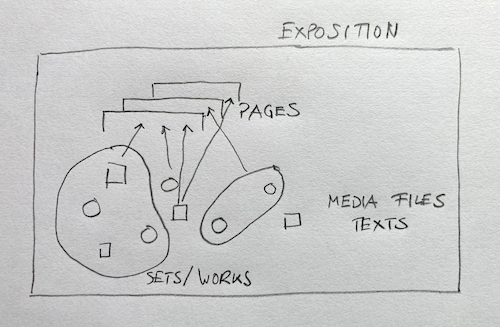
The Research Catalogue (RC) facilitates expositions of practice as research in an online environment. Its layered structure provides the technical scaffold: a data layer of uploaded media files and text; sets that assemble simple media into higher-level works; pages that add spatio-temporal order; and expositions that configure these elements. A radical understanding of exposition would apply to all layers in this stack as relational digital objects able to articulate in their respective layers: this data articulates as media file, as work, as page, as exposition, as issue, as journal, as artistic research, as culture etc. Each articulation has a different context defined by the conceptual locals of those layers.
Three consequences for expositionality follow from a polylocal approach. First, an exposition is only an object when articulated as such; it is also a complex mesh of polylocal relationships across and within framework layers. Second, data is also an articulated local not an otherwise existent entity. Third, expositional polylocality extends far beyond the RC’s layered data structures: a massive polylocal region of historical, cultural, lingual, political, and artistic consultation provides the context for an exposition, or be articulated through it.
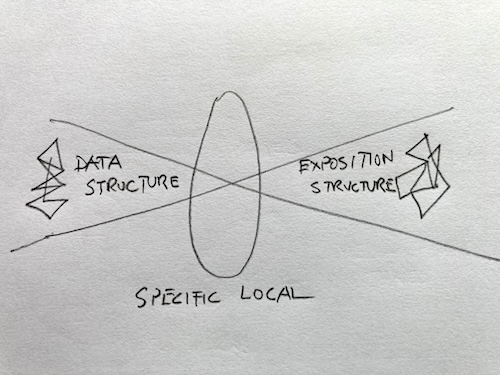
From an editorial point of view, the most striking feature of expositionality is that data structures as well as any other antecedent input seems to disappear during the reading only to reappear in a reconfigured, transposed new polylocal distribution within an exposition. This can be described as passage through an imaginary object emergent from an exposition's articulation with the specific local that is a reader. The most exciting expositions are those in which transpositional work articulates in many emergent locals independent of the structures that supposedly explain them, making me as reader see anew what I thought I had seen already. Seen in this light, expositions are generative, and reading time is required for this to take place.
ARTICULATION
Stuart Hall makes the point that, in English, articulation means both to utter or speak and to form loose connections between parts. An articulated lorry connects cabin and trailer loosely; limbs articulate around joints. This latter dimension of articulation suggests the existence of a material, a- or proto-discursive layer of meaning-making engaged with predominantly in artistic research, but potentially in all empirical and experimental sciences.
In polylocality, given an art work’s singularity, there can be no pre-existing unifying topology as point of reference for locals to meet. Rather, when two locals consult, they articulate a distorted yet becoming-shared topology. Becoming-shared, since articulation takes time and remains ongoing; distorted, since topological differences require plasticity on the part of the locals. Not everything articulates, but when it does, locals reconfigure themselves and polylocality emerges.
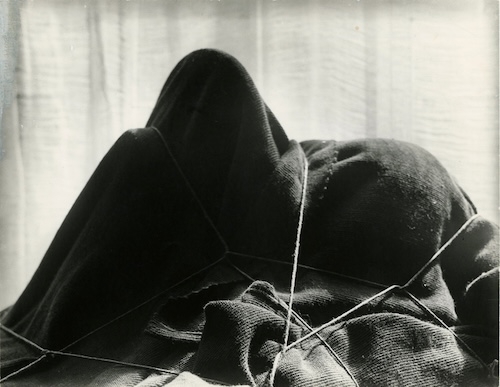
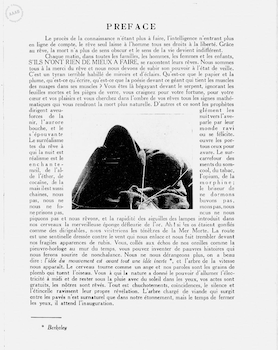
What makes 'the chance encounter of a sewing machine and an umbrella on an operating table' articulate is unpredictable. Yet somehow this encounter articulated not only in Isidore Ducasse's 19th century Songs of Maldoror but also with a constellation of surrealists. Man Ray, in 1920, made The Enigma of Isidore Ducasse, which may not look like a sewing machine and umbrella wrapped in a blanket, but this is precisely the point. Like Duchamp's Fountain, The Enigma first appeared unlabelled in the middle of the preface to La Révolution Surréaliste (December 1, 1924), which declared: 'Any discovery that changes the nature or purpose of an object or phenomenon constitutes a surreal event.' What is at work here is articulation.
Articulation must be a chance encounter precisely because no antecedent shared topology can lend the event necessity. Articulation operates in the unknown—the gaps and fissures between what is known. Moreover, articulation's event structure must be spatiotemporally deforming and hence transformative, inscribing a new timeline into the locals. Articulation need not affect locals symmetrically. One local may undergo more extensive reconfiguration than another, yet both are transformed to whatever degree for the shared topology to emerge. If articulation as distorted-yet-becoming-shared topology has a futurity, then the pasts locals left behind are not only what remains unshared and isolated, but also what serves our attempts at explanation, precisely in that cut-off fashion, as the event's substrate. Articulatory time flowing forward is connective; articulatory time flowing backward is fragmentary.
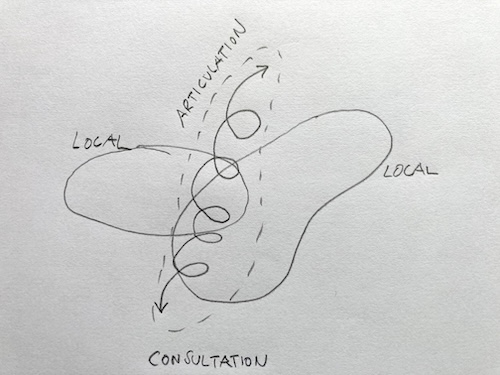
Crucially, an emergent shared topology offers a field of possibilities but does not yet constitute a stabilized local. Further articulations are needed to anchor the emergent topology within polylocality.
CONSULTATION
Articulation is how locals emerge, consultation is how they develop. While artistic research rightly focuses on new knowledge and hence on the possibility of articulation, it sits on a much wider basis of consultation that brings locals into play through active exchange. A cellist, having consulted Elgar's Cello Concerto, op. 85, will perform the piece differently after having also consulted Jacqueline du Pré's 1965 recording conducted by John Barbirolli. While there may be many articulations, they consolidate into locals with greater duration than articulatory fields only when they themselves become consulted, as du Pré's performance or Fountain continue to be.
A focus on consultation also allows for a revaluation of everyday processes rather than exceptional events. While we rightly celebrate the contribution to knowledge that a journal article might deliver, its impact is closely linked to its availability for consultation and the effect it has on consulting locals.
Focusing on a posthuman, material approach to polylocality, consultation is not something requiring human agency any more than articulation requires an articulating subject. Looking at inflammation through this lens, for instance, a foreign object is not so much attacked by a body but consulted by the body, which transforms its own polylocal fabric accordingly: blood vessels dilate, white blood cells migrate, temperature rises, and pain signals that consultation is underway. While acute inflammation might resolve through removal or encapsulation of the foreign object, we can look at chronic inflammation—particularly without clearly identifiable physical cause—as articulation of a new seemingly immaterial local, potentially and progressively over time leading to secondary symptoms and diagnoses. Pain sufferers can have names for such locals invisible to others.
A local is figured and reconfigured through consultation, its polylocal fabric in-, de-, and reformed by consultation's material exchange and embedding mechanisms. The consulted-consulting local will articulate in specific ways during consultation, in difference to its pre-consultative state, negotiating its boundary and internal differential tension as consultation proceeds over time.
SCALE
Scale is key in polylocality. To understand scale, however, the common use of the term needs a new articulation that displaces the distant observer who appears to zoom into and out of a map with ease and without material consequence. A 1:1,000,000 map of a country articulates space very differently than a 1:25,000 map used for hiking, which shows landmarks and geological detail. The consulting situation differs accordingly: the hiker crossing a mountain ridge consults the large-scale map in a specific material locality, under specific material conditions, quite unlike whoever consults the overview map from a desk.
In Edgar Allan Poe's The Purloined Letter, C. Auguste Dupin, having discovered a letter hidden by Minister D— in plain sight, explains:
'There is a game of puzzles, (...) which is played upon a map. One party playing requires another to find a given word — the name of a town, river, state, or empire — any word, in short, upon the motley and perplexed surface of the chart. A novice in the game generally seeks to embarrass his opponents by giving them the most minutely lettered names, but the adept selects such words as stretch, in large characters, from one end of the chart to the other. These, like the over-largely lettered signs and placards of the street, escape observation by dint of being excessively obvious;'
Following Dupin's reasoning, a map—that is, a given local—carries an official scale, but this is a convention of representation rather than a map's property. The map simultaneously holds features at scales both larger and smaller than its official one: the name of a continent spans the entire chart while the dot marking a village occupies a single point. The topology of the local is irreducibly multiscalar even at a given scale of representation.
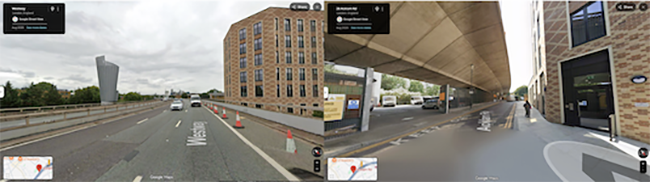
Multiscalarity is not, however, confined to questions of map-making and representation. It is a general feature of polylocality at the site of any local. The London Westway, completed in 1970, operates at a markedly different scale than Acklam Road running directly alongside it—yet both are materially present in the same place. The Westway is a genuine upscaling: counting vehicles by point of origin, for instance, it structurally addresses a vastly larger region than Acklam Road. The same can be said of Haussmann's Parisian boulevards, which operate simultaneously at the scale of the neighbourhood they were built through and at the scale of the city and state they were designed to serve. Both are real inventions that achieved new scalar reach.
Earlier in the story, Poe explains the principle of multiscalarity through a second example:
'I knew (a schoolboy) about eight years of age, whose success at guessing in the game of "even and odd" attracted universal admiration. This game is simple, and is played with marbles. One player holds in his hand a number of these toys, and demands of another whether that number is even or odd. If the guess is right the guesser wins one, if wrong, he loses one. The boy to whom I allude won all the marbles of the school. Of course he had some principle of guessing, and this lay in mere observation and admeasurement of the astuteness of his opponents.'
Upon interrogation the schoolboy explains:
'When I wish to find out how wise, or how stupid, or how good, or how wicked is any one, or what are his thoughts at the moment, I fashion the expression of my face as accurately as possible in accordance with the expression of his, and then wait to see what thoughts or sentiments arise in my mind or heart, as if to match or correspond with the expression.'
It is, in short, a consultation involving the schoolboy's material locality to give rise to a specific articulation—even or odd—at a specific moment in the game. The schoolboy does not guess an increasingly random string of events but must consult an increasingly relational and hence multiscalar sequence at once for a topology to articulate the next, right answer. As the game progresses, what for non-consulting locals looks like a random, empty string of events is, for a consulting local, an increasingly dense articulation event, whose density lies in its multiscalarity.
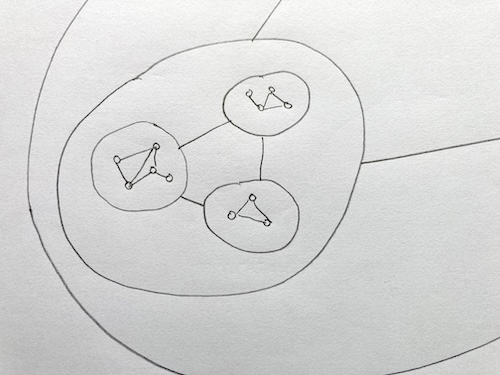
The marble game demonstrates that scaling is not a matter of zooming in or out on a fixed object but of topological transformation: the schoolboy reconfigures what counts as the local he consults with each successive guess, incorporating more of the game's history into the relational structure that articulates the next answer. This capacity to move up scale—to hold more in simultaneous productive relation—is what Poe associates at another point in the story with the poet rather than the mere mathematician. What the upward movement renders visible is striking: what at lower scales appears as external to the local becomes internal to it at higher scales. The dichotomy between inside and outside—opponent and schoolboy—thus collapses into scale relationships within what can now be recognised as a single local.
We call this upscaling that widens reach artistic because articulating new locals at higher scales requires invention. The necessity for invention arises from the structure of multiscalar consultation itself: as upscale locals articulate at their scale, they must consult downward across scales, containing what at their scale is not available as local. Instead, these other scales are present non-locally: distributed, blurred, sensed rather than grasped. The upscale local must therefore be an invented articulation that responds to what it cannot directly grasp, making creativity not an optional quality but a structural requirement for polylocality.
At the same time, as the examples demonstrate, upscale locals differ in how they relate to the locals they contain. The Westway reaches further while cutting off what lies below; Acklam Road remains visibly present yet unconsulted. Haussmann's boulevards, by contrast, maintain some relationship to their immediate surroundings even as they operate at city scale. Neither, however, is an invention that integrates across scales to the degree, however idealised, that Poe's schoolboy exemplifies.
This clarifies what artistic intelligence contributes to scalar navigation. When art and artistic research venture into the unknown, when intuition or atmospheres are invoked, we may be witnessing the artist's capacity to work with what is present non-locally. Artists are trained to sense and respond to scales that have not— or not yet—been articulated as distinct locals. Nineteenth-century conceptual frameworks, unable to theorize the non-local presence of unarticulated scales, resorted to mystification—whether it is ‘the genius,’ ‘the sublime’ or ‘negativity.’ In a polylocal framework, we can value artistic modes precisely where they operate with non-local scale presence through blur and a sensing of what is not yet articulated. Artistically, we can hold polylocality at an appropriate scale without requiring that this be mystified or inflated into transcendental claims.
ARTISTIC INTELLIGENCE
Artistic intelligence is the consultation of distributive polylocality. What is distributed are not relating objects but multi-scale consultations articulating and re-articulating as locals at specific scales. Artistic intelligence lies not in a specific knowledge but in the local capacity for dense multi-scale consultations articulating other locals. Through consultation and articulation a complex, material, polylocal fabric of relationships can develop and articulate in transformed or new locals leading to a constant reconfiguration and adaptation of what is articulated and how it consults. This is artistic intelligence at work.
This is first of all not a question of representational truth but of articulatory affect. In specific local contexts, the conceptual local of truth can consult strongly, affecting what may or may not be articulated; in other local contexts, perhaps of the kind currently developing on the level of politics, an articulation of something as true may have less or even adverse consultation effects. From a polylocal perspective of artistic intelligence, representational truth, even in a research environment, is not a given but must be consulted carefully and in specific ways to remain polylocally and artistically productive.
Chapter 1 of W.G. Sebald's The Rings of Saturn is 26 pages long. We see, in each line of the text, in each sentence, paragraph, page and image a multi-scale, shifting polylocal emerge, too vast to trace but clearly held in this articulation. Yes, given his proven track-record, we might assign artistic intelligence to Sebald, but this is pure speculation suggesting representational truth (the book as representation of its author); more important than that is how the book enacts and hence becomes a thing of artistic intelligence, and the polylocality that we can consult from this specific material articulation.
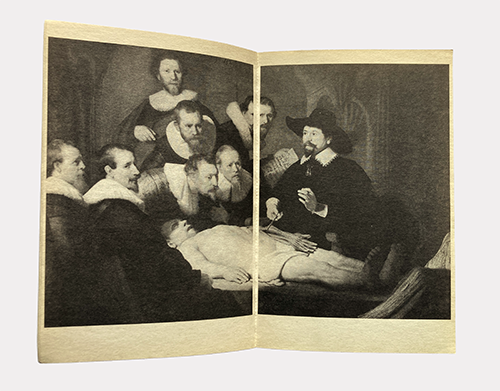
For me, in the first chapter Rembrandt's The Anatomy Lesson stands out reproduced in my English translation spread across pages 14 and 15 with a further detail inserted on the following page. The painting's articulation in the book is very precise also in what it is not: while it is a historical painting, the articulation is not about the history of art, nor Rembrandt's body of work. It is also not about historical truth despite fixing the painting locally 'in the Mauritshuis (...) precisely where those who were present at the dissection at the Waaggebouw stood' (13). Rather, the articulation of Rembrandt's painting is embedded in longer tentacles that reach from the subject-narrator's hospitalisation in Norwich, past his deceased acquaintances Michael Parkinson and Janine Dakyns to Flaubert 'who was guided by a fascination for obscure detail rather than by the self-evident' (7) preparing the reader not only for a sense of death but also accumulating a resonant polylocal body of densely related details where 'every speck of dust weighted as heavy as the Atlas mountains' (8).
This and much more lead the way to the painting, which we are, so it seems, invited to contemplate in the light of what has been said and, also, what we ourselves bring to the book. Having had our chance in seeing, the text proceeds in giving a more specific locality, both in image and words, not only of Aris Kindt's hand but also of artistic intelligence able to consult through a 'speck of dust' (Kindt's hand) 'the Atlas mountains' (the injustice). Sebald writes:
'Now, this hand is most peculiar. It is not only grotesquely out of proportion compared with the hand closer to us, but it is also anatomically the wrong way round: the exposed tendons, which ought to be those of the left palm, given the position of the thumb, are in fact those of the back of the right hand. In other words, what we are faced with is a transposition taken from the anatomical atlas, evidently without further reflection that turns this otherwise true-to-life painting (if one may so express it) into a crass misrepresentation at the exact centre point of its meaning, where the incisions are made. It seems inconceivable that we are face here with an unfortunate blunder. Rather, I believe that there was deliberate intent behind this flaw in the composition. That unshapely hand signifies the violence that has been done to Aris Kindt. It is with him, the victim, and not the Guild that gave Rembrandt his commission, that the painter identifies. His gaze alone is free of Cartesian rigidity. He alone sees the greenish annihilated body, and he alone sees the shadow in the half-open mouth and over the dead man's eyes.' (16f.)
Artistic intelligence allows for multi-scale consultations to form new articulations that, like Aris Kindt's hand on Rembrandt's painting, need not be 'true-to-life' but have the ability to connect what seems unconnected and to articulate consultable locals with transformative potentials.
CONTEXT DENSITY
Consultation proceeds along gradients of topological difference. These gradients reflect both contextual incompatibility (content differences between topologies) and context density differences (how knowledge is topologically held). They drive processes of mutual, asymmetric transformation that articulate as specific locals. In this theory of polylocality, the context density gradient is of particular importance: a steep negative gradient—where consultation flows from high to low context density—signals extractive transformational relationships, since consultation toward the low-density side becomes decontextualizing, lacking sufficient context density for adequate transposition.
Context density manifests only through articulation: it is not a property that locals possess independently but emerges from the consultative demands enacted when locals articulate. Two dimensions characterize this emergence: the embedded dimension expresses what multiscalar contexts have been incorporated into the local through its constitutive articulation, while the invoked dimension expresses what multiscalar contexts must be called upon from other scales during a specific consultation. Neither dimension exists prior to articulation—they become accessible only as locals engage in consultation, revealing the scalar work required for their articulation to occur.
During consultation, different locals make different demands. An instruction manual, when consulted, typically requires minimal invocation of external contexts (low invoked dimension) because extensive context has been embedded through its design (high embedded dimension). A philosophical treatise page, when consulted, may simultaneously present densely embedded context while requiring extensive invocation of contexts from other scales—philosophical traditions, conceptual frameworks, historical debates (high embedded, high invoked). A simple form with blank fields requires little embedded context but, when consulted within specific institutional frameworks, may invoke extensive regulatory, legal, and procedural contexts (low embedded, high invoked). Since both dimensions manifest through articulation, they are equally real; a local with low embedded but high invoked dimension exhibits high context-density because both dimensions, though asymmetric, are present and operative in the consultation.
Context density estimates must therefore be parameterized by the consulting contexts themselves: it requires specifying which local consults which other local under what conditions. The embedded dimension can be estimated by analyzing the scalar span incorporated into a local's articulation: how many scales, registers, and topological regions does it hold in relation? The invoked dimension, however, varies with the actual consultation occurring: the same local will invoke different contexts when consulted within EU legal frameworks versus literary criticism versus everyday communication. This does not make context density estimates arbitrary; certain locals consistently require extensive invocation across diverse contexts (high context density), while others permit articulation with minimal scalar engagement regardless of the consulting framework (low context density).
Such an estimation framework, which may be exciting to some, however, presents an ethical paradox: institutionalizing polylocality through standardization requires consulting diverse locals through a common framework, which risks the very extraction polylocal theory seeks to resist. Colonial power operates precisely through this mechanism—measuring everything against the colonizer's own consultative context, thereby rendering invisible the contexts that cannot be invoked within that framework. Yet context density gradient measurement could also serve defensively: locals could use it to anticipate extraction, making steep negative gradients visible before consultation occurs and providing clear arguments for refusing consultations that would require decontextualization, or for demanding institutional conditions that preserve context density.
With or without explicit context density estimation or measurement, we must avoid treating all extraction as ethically equivalent. Extraction is, fundamentally, a necessary function of polylocality: articulation extracts a local at a specific scale from its multiscalar environment. The local I call myself is extracted from other locals—bacteria in my gut, cells composing my body, my immediate family, culture, species. A work of art is likewise extracted from artistic practice under specific cultural conditions that enable rather than obstruct contemporary polylocality. Critically, what counts as extraction depends on the scale from which we consult and degree of polylocality it is able to maintain at that scale.
From this perspective, publication in JAR is not only defensible but enabling: without such expositions, artistic research's capacity to articulate knowledge would remain obstructed. However, publication becomes indefensible when it operates along steeply negative context density gradients. These could be at the site of editorial consultation itself or through successive extractions that fail to enrich, or even sustain, the practices from which knowledge is drawn. While extraction through consultation is necessary for articulation, it must proceed bidirectionally: all consulting locals must undergo transformation meaningful to their own articulation through the engagement.
RESERVE
Fat is the body's reserve, yet popular culture misreads it as waste: food unnecessarily consumed, nutrients squandered, energy wasted through exercise, or matter directly extracted and disposed through liposuction. These approaches treat fat as dead storage—inert accumulation awaiting elimination. But reserve is not storage. Storage implies passive material held until extraction; reserve implies matter actively sustained through ongoing consultation. Storage waits to be consumed; reserve sustains without depletion. The difference is ontological: storage is dead matter; reserve is living consultation.
Without reserve, a local cannot absorb consultation. It has no dimensional thickness to deform under consultative pressure, no temporal buffer to allow articulation to develop at its own pace, no context density to sustain complex relational engagement. A local without reserves must extract immediately from every consultation to survive. Such a local cannot afford the intransparency, the duration, the non-productive articulation that high context density polylocality requires. Reserve enables what extraction prohibits: the capacity to engage symbiotically, to affirm through consultation rather than deplete, to invoke dimension without exhausting it.
When we speak of ‘fat’ in everyday language, we typically mean adipose tissue, that is, a biological organ system distributed across the body in distinct depots, where each location articulates the same tissue differently. Transplantation experiments reveal this dramatically: when visceral fat is relocated to subcutaneous sites, gene expression for key adipokines changes dramatically, indicating that location determines function more than intrinsic cellular properties. The distributed adipose network communicates with the rest of the body along multiple channels, where changes to the body through nutrition, exercise, or disease affect the tissue distribution unevenly, triggering rebalanced articulation. Each depot exhibits high invoked dimension: its metabolic function depends on consultative contexts that extend far beyond the depot itself.
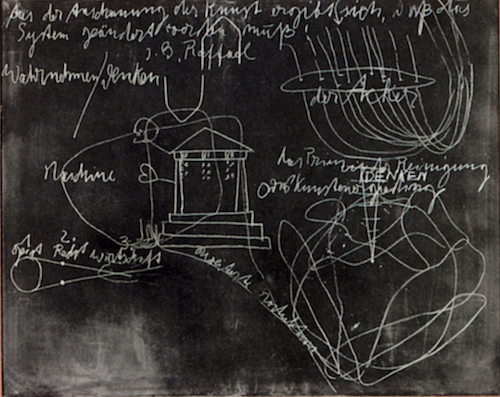
This polylocal understanding of adipose tissue as distributed reserve finds resonance in Joseph Beuys's artistic practice. Whether historical fact or foundational myth, Beuys recounted being rescued by Tartar tribesmen after his plane crashed in the Crimean mountains on March 16, 1944, wrapped in felt and fat to prevent death. This narrative positions fat not as extractable resource but as life-sustaining reserve, as material capacity called upon for healing. For Beuys, fat operates as abstract material capacity rather than concrete sculptural substance. His fat works do not represent reserve but enact it: material that resists immediate extraction, that transforms temporally, that maintains capacity through ongoing environmental consultation rather than isolated preservation. This approach extends to his concept of social sculpture (Soziale Plastik), which articulates not only art but human capacity itself as reserve under threat in extractive systems.
Reserve, however, is not primarily the capacity of a local but the context-density enacted through consultation and articulation. Extraction occurs not through any single consultative act but through sustained patterns of consultation that progressively reduce a local's scalar depth and, hence, its capacity to articulate across multiple context-densities and scales. Affirmation, conversely, operates as consultation that maintains or expands scalar depth: engaging a local in ways that preserve its ability to invoke dimension across registers, to modulate between consultative densities, to sustain reserves for articulations not yet called upon.
In polylocality, consultation literally matters—it is never neutral, always transformative. A local, participating in multiple multiscalar consultations simultaneously, must continuously negotiate these engagements. Sustained consultation strain can flatten a local's articulated topology, reducing its scalar depth, or, if topological shearing becomes too strong, disintegrate the local entirely. Consultation policies and protocols therefore become crucial, requiring protection of locals from forced consultation and maintaining reserves that counterbalance extraction through affirmation, sustaining the distributed capacities through which polylocal networks preserve scalar depth without depletion
PROVISION
JAR's key concern has shifted over the years from the embedded context-density dimension of expositions to their invoked dimension. Initially, we black-boxed the invoked dimension in diffuse notions of 'peers' and a more passive approach to publication, with less focus on audience differences. Today, building on the stable environment that both the RC and its communities provide, we are much more challenged to engage with the invoked contextual dimension. We ask how expositions can consult without extracting context from their readers, or how they can consult across differences while affirmatively fostering richness. This has been a longer process, driven by an increasingly diverse editorial board, the problematisation of English as working language, and changes to editorial and peer review policies.
The Research Catalogue, despite its success, faces a different challenge: to risk its own ontology, which is built on long-standing presuppositions about what an author or owner is, what public or private means, and where knowledge actually resides. Machine learning offers a productive provocation here, allowing us to connect material articulation efforts across artistic research and artificial intelligence through notions of embedding, context, and transposition rather than, as has been the story to date, knowledge through discursive representation. This lecture was intended as a prolegomena to that confluence — as artistic intelligence.
Both concerns — epistemic diversity and its non-extractive technological harnessing — point, in their different ways, toward governance models that may now be in formation. Let us assume for a moment that artistic research has not only been a byproduct of European academic reform but expresses a cultural and political will within Europe to enjoy and harness rich local differences for a common good. As such, artistic research forms part of a much wider European search for resilient and affirmative governance models, where the upscaled local is neither a super-state nor a deregulated competitive zone at the level of the nation state or neoliberal capitalism. Europe's resistance to deregulation while deferring integration may, approached optimistically, be a sign of precisely that will.
I want to propose that context density and scale offer tools to re-evaluate reality, provided we replace the assumption that governance rests on low context-density and narrowly scaled rules with consultation and articulation: a new, radical, material approach. At the lower scales, even within centralised European policy, this already works remarkably well. COST Actions like this one, Erasmus, and emergent transnational and transregional networks such as Eurocities or Interreg create spaces for transformative yet non-extractive consultation. More difficult is the invention of upscaled locals that sustain such consultative relationships. It is here that policy tends to become decontextualising and, hence, extractive. What if context-density gradients could be estimated or even measured to guide choices toward multiscalar polylocality, or at least to raise awareness of what is required to maintain reserve as locals adapt?
If so, we could no more equate a small local farmer with an industrial producer only by their products than we can equate the Westway with Acklam Road simply because they occupy neighbouring land. Context extraction must carry a price — one which, if properly internalised, would rebalance the scales: not in all cases toward smaller farms, but toward the contextual responsibilities of large producers. The same logic could apply to copyright. Where context is not extracted, appropriative articulation might be licensed; where it was, i.e. when an artwork is used in an advertising campaign or to train a model, a licence might be withheld or a fee structure invoked. Artworks could circulate freely across high context-density environments while being protected from extractive decontextualisation.
Framed in this way, artistic intelligence is not primarily about anything narrowly 'artistic'. It names a different, material framing of meaning, one that is modelled on art's articulatory requirements, and with implications that reach well beyond art.
Biography
Michael Schwab is the Editor-in-Chief, Journal for Artistic Research (JAR). Profile page: https://jar-online.net/en/node/15